
Loading...
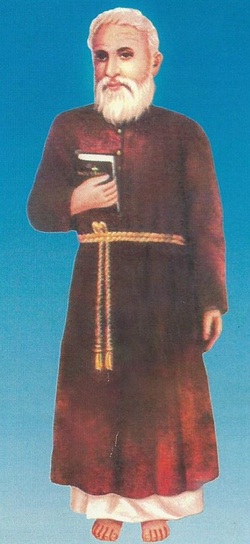
Thommechan was born on the 8th July 1836 and was baptized as Thomas. When Thommechan was about two years and a half old his father, Philippose died.His mother, Thresiamma then looked after him.
Proficiency in Tamil enabled Thommechan to read first hand several religious and devotional books in Tamil. Most of the books available then were in Tamil. Prominent among them was the Bible and lives of the Saints including that of St. Francis of Assisi.
He was prone to be prayerful contemplative, ascetical, withdrawn. He would concentrate on devotional exercises and prayers and seek solitude and meditation.
He got married to Annamma, daughter of Mathachan, Vadakkeveettil of Pulincunnu parish. She was just an ordinary, normal catholic girl, not particularly given to be over-enthusiastic about the pious practices of her bridegroom. But Thommechan's sense of values and piety made him a loyal and dutiful husband. So he gave in to all that was expected of him as a husband and father.
In the normal course of his family life a son and two daughters were born to him.
Thommechan was born on the 8th July 1836 and was baptized as Thomas. When Thommechan was about two years and a half old his father, Philippose died.His mother, Thresiamma then looked after him.
Proficiency in Tamil enabled Thommechan to read first hand several religious and devotional books in Tamil. Most of the books available then were in Tamil. Prominent among them was the Bible and lives of the Saints including that of St. Francis of Assisi.
He was prone to be prayerful contemplative, ascetical, withdrawn. He would concentrate on devotional exercises and prayers and seek solitude and meditation.
He got married to Annamma, daughter of Mathachan, Vadakkeveettil of Pulincunnu parish. She was just an ordinary, normal catholic girl, not particularly given to be over-enthusiastic about the pious practices of her bridegroom. But Thommechan's sense of values and piety made him a loyal and dutiful husband. So he gave in to all that was expected of him as a husband and father.
In the normal course of his family life a son and two daughters were born to him.
In 1865, when Thommechan was about 28 years old, he called together a number of his like minded companions, all bent on consecrating their lives in the service of God, without renouncing their temporal responsibilities. He had heard of the distinguishing Franciscan Cord as a symbol of restraint - something that would tie up your wandering or bursting thoughts - something that would remind you that you are tied to, bound to, a mooring point, a focus of spirituality. He found the thin strands of a coconut fiber robe, with its sharp, strong and piercing bristles as a suitable inner girdle to be worn close to the body. This physical gesture was supplemented by some self imposed regulations conducive to a virtuous living and external works of charity like helping the poor, conversion of the depressed classes, more systematic observance of the Sabbath etc. One day during the spiritual reading they were making at their Sunday meetings, this prayer group came across the story of the foundation of the Third Order by St. Francis of Assisi, for married people living in the world. Soon Thommechan procured a copy of the rules of the Franciscan Third Order. Thommechan saw that St. Francis and his brother friars actively engaged themselves in missionary activities and felt that, that was the immediate call open to his fraternity. There were around him plenty of Harijans who were living in subhuman conditions, denied of all rights of equality with their brethrn in the matter of education, worship, use of public highways etc. Untouchability and unapproachability were among the vices prevalent among them.The fraternity put up a shed in the common lands there and organised the teaching of catechism in groups formed according to age. This association of Thommechan with the low caste people raised protests from the well placed families.
This fraternity was distinguished by the rope they tied around their waist. They were even addressed as "the fraternity of the roped". Braving such ridicule, Thommechan worked on enrolling more members in different parishes. He travelled all over Kerala preaching the Franciscan message in the churches. From 1868 onwards Thommechan was engaged in this mission and he succeeded tremendously in spreading the Franciscan message throughout Kerala.
On the 26th Dec. 1868, the feast of St. Stephen, he was vested. Following the common practice of the religious, of chosing an alternate name, as a mark of their shedding their old personality and accepting a new one, Thommechan chose 'Louis' as a sur-name. From then on, Thommechan was known in the religious fraternities as Thommen Louis. St Louis is the patron saint of the Franciscan Tertiary brothers.
Thommechan died on 1st November 1908.
Puthenparambil Thommachan, popularly known as Kerala Assisi, was declared as ‘Servant of God’ on Friday 29th June 2012..
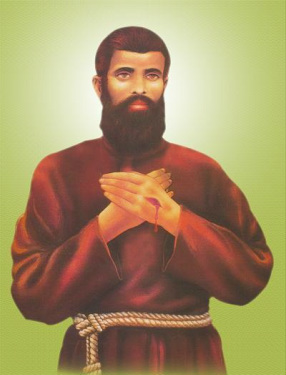
Br. Joseph Thamby, a Perpetual Franciscan Tertiary was born in September 1883 in Karaikal village and brought up in Pondicherry in the southern state of Tamil Nadu, India. His parents were Savarymuthu Thamby and Annamalle. Br. Thamby lost his mother when he was seven years. His father married a second time. On account of the adverse circumstances created by his step-mother, Joseph Thamby left the house stealthily and reached Kerala where he was taken care of and educated by a pious lady. He must have worked there taking care of the household works and at the same time, receiving good religious education.
He made frequent visits to his birthplace, where he was unrecognized by anyone; even his father gave him some coins without recognizing him. Only in 1928, he was recognized by his grandmother at a funeral service of a relative. Again on 14 October 1932, he turned up at the religious profession of his niece Gabrielle Marie Therese OCD (died in 1985) in Puducherry. On this occasion and according to the testimony of Gabrielle Therese, he was dressed in a Franciscan habit. She remembered him saying that he had to return to his Friary at Kollam in Kerala. He was then 50 years old.
The construction of St. Antony’s Friary, the student house at Kollam in Kerala was supervised from 1931 by a French Capuchin, Symphorian of Paris and the same was inaugurated in 1932. We assume that Joseph Thamby must have joined the Capuchins in 1931 or 1932 at Kollam, Kerala. It used to be customary among the Capuchins for postulants of the Order to be first received into the Franciscan Third Order and clothed in the habit (without a hood, with a cord and rosary), then into the novitiate and finally as professed members, before subsequently entering the novitiate of the friars. Thus, Joseph tried to join the Capuchin Order. For sure, his being aged fifty was not in his favour.
Nevertheless, after leaving the Capuchins, the Tertiary Brother Joseph Thamby continued to wear the habit, as confirmed by a few photographs and a number of testimonies. He remained a staunch member of the Third Order and took upon himself the mission of spreading the Order wherever possible.
In 1933, Br. Joseph Thamby came to Manathidal (now a parish in the diocese of Kumbakonam, Tanjavur district, Tamil Nadu). Some people thought that he belonged to a lower caste, because he was dark. They planned to chase him away from the place but, gradually, they realized that he was a saynyasi (monk). They tolerated him observing keenly his way of life. As a result, the Catholics of Manathidal began to be attracted by the spirit of prayer, austerity and generosity of Br. Joseph Thamby. They gave him food and accommodation. He taught them catechism, established peace among people and prepared for the feasts of the locality. He taught them about the life of St. Francis of Assisi, his Order and especially the Third Order (Secular Franciscan Order). Some of them wanted to join and as a result, he established a branch of the Third Order there. It is said that from here, he extended his service and ministry also to Kumbakonam and Tanjavur.
His life in Manathidal was humble and poor. He stayed in a tiny tin shed near the Church. He was totally dependent on the people for his living.
Br. Joseph Thamby moved to Pachamalai (Kumbakonam Diocese and in the district of Thirichinapally, Tamil Nadu) in 1936 for social and evangelical work among the hill-tribes who were considered to be primitive. They were 8 Kilometers away from Kothapalayam parish church, and he stayed there in a hut for pretty long time engaged in social service specially providing clothes for the poor people. He used to collect clothes and even money from Pondicherry for the poor people of Pachamalai. His life and service in Pachamalai was noteworthy. He identified himself with the poor tribal people there. He tried to educate them and worked for their up-lift in the society.
He used to treat wounded people with the country medicine he knew. His desire was to construct a church for which he bought a piece of land. But, when some priests, thought that it would be very difficult to establish the church among those tribal people and as a result they sold the land. With this, Br. Joseph Thamby left Pachamalai.
In Kerala, he would work in the fields as a daily wage earner or beg alms in streets and share what he earned with the poor. Much of the help he got, he use to send to Vijayawada in Andhra Pradesh for the help of the poor. Br. Joseph Thamby prayed for the sick and for the conversion of sinners.
Brother Joseph Thamby moved from Kerala to Bittragunta, Nellore district in Andhra Pradesh and did his ministry there among the Railway employees who were mostly from Tamil Nadu for eight months.
Towards the end of 1937, he reached Kesarapally which is about 25 KM away from Vijayawada, Andhra Pradesh. There Br. Joseph Thamby picked up workable knowledge of Telugu and used to gather people for Rosary, lead them to Eucharistic celebration in the parish church at Pedavutapally.
In the beginning of 1939, he decided to change his residence from Kesarapally to the premises of the parish church at Pedavutapally for the love of the Eucharist.
The Boyapati family (Basavayya and Sitaramamma) was the one that he brought to faith in Pedavutapally through which many more. The family showed concern and care for Br. Joseph Thamby and he responded with interest in this family. This mutual love and appreciation grew gradually and in course of time this family became receptive to God’s Word. The parish priest was kept in know of these developments in that family. He encouraged the efforts of Br. Joseph Thamby. On 22 July 1939, at night, the family was baptized and received the names Francis and Claramma. He built an altar in honor of St. Francis of Assisi in Boyapati family which we can see even today.
The funeral was postponed to the following day for more people were flocking to Pedavutapally from various remote villages. The funeral Mass was attended by hundreds of people. The anniversary of his death is celebrated with great solemnity, with the participation of tens of thousands of devotees from 13 to 15 January every year.
Br. Joseph Thamby was blessed with the rare spiritual gifts of Stigmata, bi-location/instant location, Prophecy, Visions, curing the sick, multiplying the food, intuition into the minds of the people and many spiritual healing powers. He had a workable knowledge of Telugu, Tamil, Malayalam, French and English.
He devoted a considerable time in private prayer both day and night. He had a great devotion to the sacrament of Holy Eucharist and Reconciliation.
Br. Joseph Thamby was a man of penance. Perhaps, his main penance was to suffer the pains of his stigmata. Besides this, he practiced other voluntary penances, like bodily mortification and fasting. He was often wearing a belt with small chains attached to it. This was found after his death.
He use to speak aloud with the people who tread in wrong path, but later, he use to feel so sorry for his anger and beg pardon by bending or kneeling in front of the person catching their legs. In order to persuade certain hard-hearted Catholics to go to the Church, he would kneel before them and humbly entreat them to go for Mass. Sometimes, even before disobedient children, he would kneel down and request them to obey.
Many people affirm the fact that Br. Joseph Thamby was given the extraordinary favour of receiving the stigmata. On Fridays he was seen in agony by many, and at times in ecstasy, which means he might have been participating in the passion of Jesus Christ.
The testimony about the stigmata of Br. Joseph Thamby given by Fr. Vincenzo Pagano. He was visibly in great pain, as his short hairs were straight up, the eyes blank, the body hunched and almost crushed and barely able to walk. I noticed fresh blood stains in his hands, on his feet and on his heart. He confided to me that he receives the stigmata on every Friday and lasts for full hour. After few months, I began noticing, besides the five wounds, even a scar of red drops shining, ruby-like, all around his head. On good Fridays, he locked his room the whole day and God alone knew how much he suffered. He avoided visiting villages on those days and was afraid so much of being seen by others. At the time of the stigmata, he appeared to shine beautiful with much grace reflected on his face. The legs of Br. Joseph Thamby, which were joined together as if in a nailed position. He was lying in the form of a Cross and was writhing in excruciating pain. Later, returning to consciousness, Br. Joseph Thamby asked for some piece of cloth to wipe away the stains of blood, after which the wounds seem to have disappeared from his hands and feet. Br. Joseph Thamby in his own words said, “every Friday at 3 p.m. I experience within myself the pain of crucifixion and the blood starts to flow.’
He foretold the date of his death three months in advance and prepared the coffin. During the three months preceding his death, Thamby became very austere in his life. He would fast daily on black coffee and an occasional dish of some edible roots, which was locally available. He continued to visit the villages. He was struck by a fever, on 6 January 1945. His works in the villages, his frequent fasts and many austerities had irreparably undermined his health. On 15 January his condition worsened. He had the desire to die in Boyapati family. Surrounded by the Boyapati family, whom he himself had converted, and by various friends and devotees, as he foretold God called him for his eternal reward on 15 January 1945 at 4:00 PM at the age of 61.
"Servant of God": It is the title given to a deceased person of the Catholic Church whose life and works are being investigated in consideration for official recognition by the Pope and the Catholic Church as a saint in heaven. The process for canonization is under the jurisdiction of the Congregation for the Causes of Saints. Receiving the title Servant of God is the first of the four steps in the canonization process. The next step is being declared Venerable, upon a decree of heroicity or martyrdom by the honored. This is followed by beatification, with the title of Blessed, after the confirmation of miracles attributed to the honored. The final step is canonization, where the honored would receive the title of Saint.
He was declared 'Servant of God' on 24 June 2007.
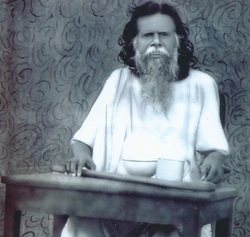
His full name was Paul Chinnappa Reddiar, aka Peter Reddy / Paradeshi Peter. He is also known as the greatest learned mendicant the world has ever seen. He was born at Perioor Ammapetei, Thirumangalam, Madurai district, Tamil Nadu. He was a teacher by profession with degrees in M.A, L.T (B.ed of today). Except Tamil and English, he learnt Hindi, Sanskrit, Malayalam, Italian, German, French, Hebrew and Aramaic after the age of fifty. He is credited to have written 9 books and over 50 Tamil devotional songs. His spirituality emphasized on evangelical poverty, evangelical mission, ascetic life and obedience to the call of Jesus and the Church.
“I do not look at the man who insults me but look at Jesus standing behind him. I will do as Jesus did when he was insulted.”
He was greatly devoted to the Holy Eucharist and to our Lady. He was influenced by St. Francis of Assisi and St. Alphonsa.
He renounced the world, became a beggar to practice the word of God and preached Christ. Even while working as a professor, he was never hesitant to sacrifice anything for evangelization. After a 3 day retreat in Amal Ashram, Trichy, he made his commitment for life to preach the Gospel as a Franciscan Mendicant Brother. On the instructions of Fr. Urban OFM Cap., in 1944, he renounced everything. He quit St. Xavier’s College, Palayamkottai, as a professor. He went out with a beggar’s bowl, the Holy Bible, putting on the brown habit of the capuchins minus the hood and tied a cord around his waist. Though he was an eminent scholar and a university professor, on many occasions he used to sit among the beggars, people irrespective of their class, caste, creed or color. He later on changed to saffron attire and went around with his begging bowl. He died on 21st June 1958 and is buried at Palayamkottai.